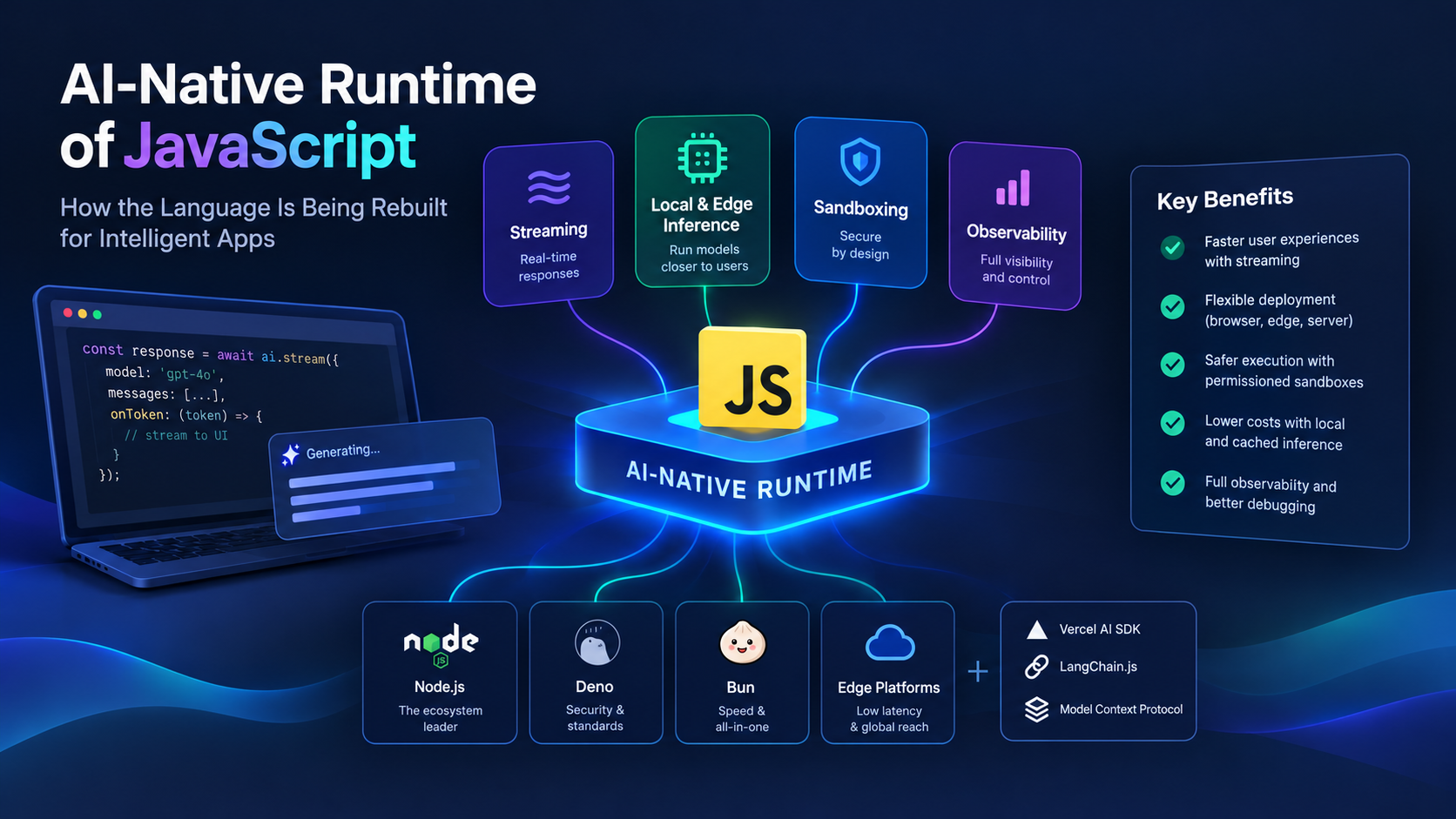
AI-Native Runtime of JavaScript: How the Language Is Being Rebuilt for Intelligent Apps
JavaScript has outlived every prediction of its decline. It escaped the browser, took over the server, and now powers everything from checkout flows to analytics dashboards. But the most important change happening today has little to do with syntax. It is happening in the runtime, the layer that actually executes your code.
As AI features move from side experiments to core product behavior, that layer is being reshaped around them. An AI-native runtime of JavaScript is an execution environment where model inference, token streaming, agent tool calls, and secure sandboxing are first-class concerns instead of bolted-on libraries. This guide explains what that means, why it matters, and how your team can prepare.
What "AI-Native" Really Means
Classic JavaScript runtimes were built for short request-response cycles: read a file, query a database, return JSON in a few milliseconds. AI workloads break that pattern. They stream output gradually, they stay open for seconds or minutes, they call external tools, and they execute instructions that a model generated rather than a human wrote.
An AI-native runtime accepts those traits as the default case. It handles long-lived streams without drama, exposes inference capabilities through simple APIs, isolates untrusted code by design, and gives developers visibility into what a model actually did.
Why the Old Model Starts to Strain
Consider a typical AI chat feature built on a conventional Node.js server. The backend calls a model API, receives a stream of tokens, forwards them to the browser, logs usage, and sometimes runs a tool the model requested. Each step needs glue code, and every piece of glue is a place where latency, memory leaks, or security gaps can appear.
Three pressure points show up repeatedly. The first is streaming reliability: backpressure, dropped connections, and partial responses are common when output arrives token by token. The second is untrusted execution: when a model writes code or chooses a tool, you are running logic nobody reviewed. The third is cost visibility: token usage, retries, and cache misses quietly inflate bills unless the runtime reports them clearly.
An AI-native approach moves these concerns closer to the platform so application developers stop reinventing them.
Core Capabilities of an AI-Native Runtime
Streaming as a Primitive
Web Streams are already part of the modern JavaScript standard library, and AI-native tooling leans on them heavily. Instead of waiting for a complete answer, applications render partial output immediately, which makes interfaces feel dramatically faster even when total generation time is unchanged.
Local and Edge Inference
Hardware acceleration through WebAssembly and WebGPU lets small models run directly in the browser or on lightweight servers. Libraries such as Transformers.js and ONNX Runtime Web already demonstrate this. Running a classification or embedding model near the user cuts round trips, protects sensitive data, and reduces dependence on a single provider.
Permissioned Sandboxing
Deno popularized explicit permission flags for file, network, and environment access, and other runtimes have been adding comparable controls. For AI-native systems this matters enormously. If an agent generates a script, the runtime should let it touch only what you allowed, nothing more.
Built-In Observability
Tracing every prompt, tool call, and token count should be as routine as logging an HTTP request. Runtimes and frameworks that expose these signals natively make debugging and cost control far easier.
The Runtime Landscape Today
No single product owns the label yet. Node.js remains the dominant production choice, with a huge ecosystem and steady additions such as built-in fetch, web streams, and a permission model. Deno emphasizes security and standards compliance. Bun focuses on speed and an all-in-one toolchain. Edge platforms such as Cloudflare Workers and Vercel's edge functions run code in lightweight isolates close to users, which suits low-latency streaming and inference routing.
Meanwhile, the Vercel AI SDK, LangChain.js, and the Model Context Protocol are turning model calls and tool connections into standard patterns that work across these runtimes. The practical takeaway is that AI-native is a direction of travel, not a single download. Teams that choose standards-based APIs today will adapt more easily as the platforms mature.
Agents, Tools, and the Runtime
Agents are where the runtime question becomes urgent. A multi-agent system coordinates several model-driven workers, each calling tools, sharing context, and recovering from failures. The orchestration layer needs durable state, predictable concurrency, and strict boundaries between agents. If you are weighing options for this layer, our comparison of multi-agent orchestration frameworks walks through the trade-offs in detail.
JavaScript is well suited to this work because its event loop handles many concurrent, I/O-bound tasks gracefully, and because one language can power the agent logic, the API, and the user interface. That end-to-end consistency shortens feedback loops and lowers hiring friction.
Security Cannot Be an Afterthought
Prompt injection, data leakage, and over-privileged tools are the new attack surface. A model that can call a payment API or read a customer record is only as safe as the permissions around it. Apply least privilege to every tool, treat model output as untrusted input, and log sensitive actions for audit.
Organizations in regulated sectors should pair this with a broader security review. DevLogix's cybersecurity services and our guide to enterprise ransomware prevention cover the foundations that AI features must sit on top of.
Cost and Infrastructure Considerations
Choosing where inference runs, in the browser, at the edge, on your own server, or at a managed provider, is a cost decision as much as a technical one. Small models on the client are nearly free per request but limited in capability. Hosted models are powerful but billed per token. A hybrid strategy usually wins: route simple tasks locally, reserve large models for complex ones, and cache aggressively.
For a wider view of infrastructure spending, see our breakdown of AWS vs Azure vs GCP cost optimization, and explore our cloud and DevOps services for deployment pipelines built around these patterns.
What This Means for Product Teams
Frontend frameworks are adapting quickly. React Server Components and Next.js make it natural to stream AI-generated content from server to interface, a pattern we discuss in our guide to enterprise Next.js and React development.
SaaS products gain the most immediate benefit, since in-app assistants, smart search, and automated workflows are quickly becoming baseline expectations. See how we support SaaS companies. Fintech teams can apply the same patterns to support automation and risk signals, as long as compliance is designed in from the first sprint, which is where our fintech expertise applies.
How to Prepare Your Team
You do not need to rewrite your stack. Start with these practical steps:
- Audit your current Node.js version and adopt standard APIs such as fetch and Web Streams.
- Wrap every model call behind a thin internal interface so you can swap providers or run models locally later.
- Define permissions for each tool an agent may use, and deny everything else by default.
- Track token usage, latency, and failure rates from day one.
- Prototype one small feature, such as semantic search or summarization, before committing to a larger roadmap.
If you lack the capacity to do this in-house, comparing in-house developers vs staff augmentation can help you decide how to scale without slowing delivery.
Conclusion
The AI-native runtime of JavaScript is not a single product launch. It is a gradual convergence of streaming, sandboxing, local inference, and observability into the platforms developers already use. Teams that adopt standards-based practices now will ship smarter features faster and avoid costly rewrites later.
Ready to build? DevLogix designs and delivers AI-powered JavaScript products for ambitious teams. Explore our web development services and AI and ML services, learn more about us, or contact our team to discuss your project. You can also browse more engineering guides on the DevLogix blog or start from the DevLogix homepage.