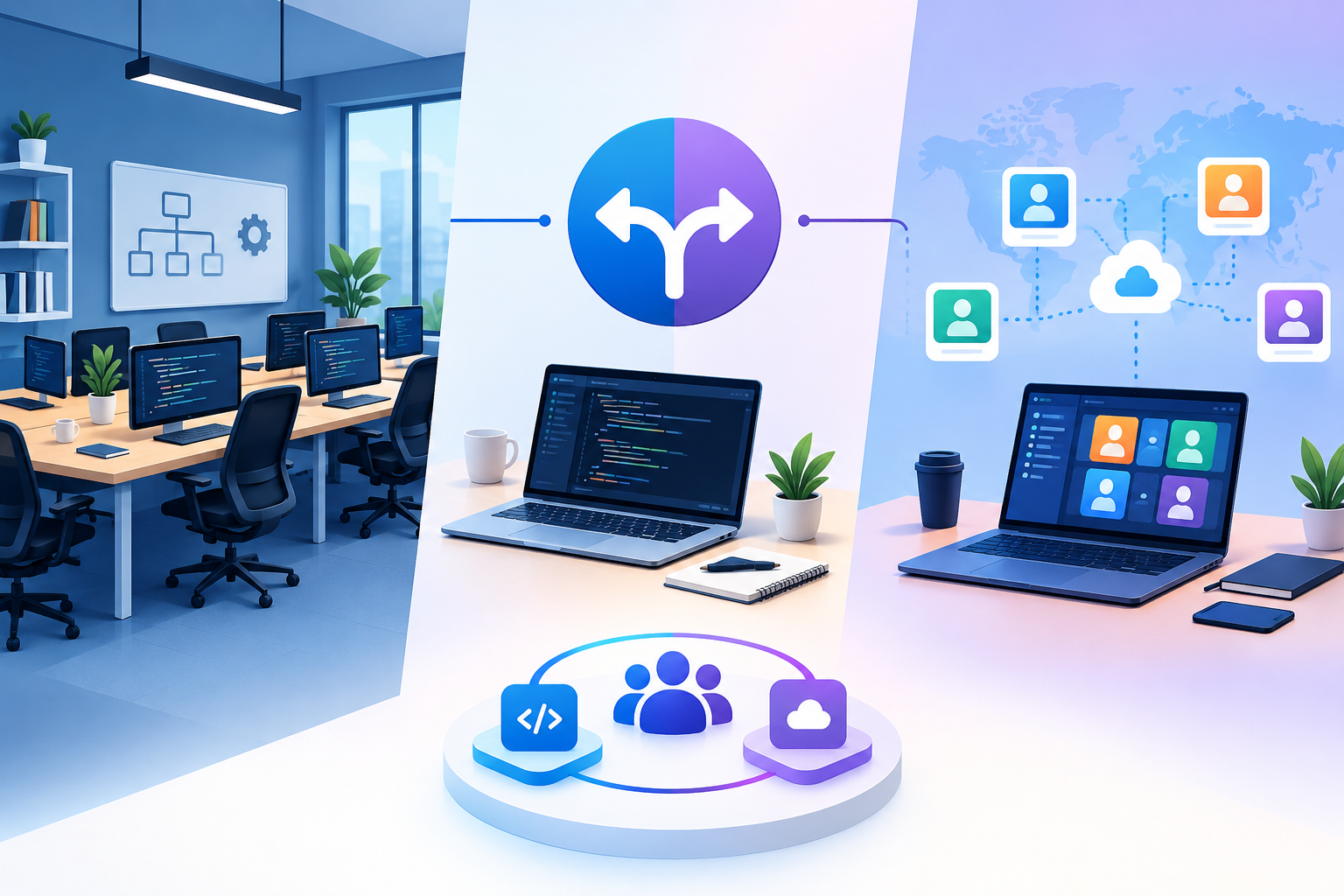
In-House Developers vs Staff Augmentation: Which Fits Your Growth Strategy?
Every growing company eventually hits the same wall: the product roadmap is moving faster than the engineering team can keep up with. When that happens, leaders are left choosing between two very different paths — build a permanent in-house development team, or bring in outside specialists through staff augmentation. Both approaches can deliver great software. The difference is in cost structure, hiring speed, flexibility, and how much control you keep over the day-to-day work.
This guide breaks down how in-house hiring and staff augmentation actually work, what each one costs in practice, and how to decide which model — or which mix of the two — fits your growth stage, budget, and technical roadmap.
What Does "In-House Development" Actually Mean?
In-house development means hiring engineers, designers, and QA staff directly as full-time employees of your company. They sit inside your organization, follow your HR policies, use your equipment, and typically work on your product exclusively, long-term. It's the traditional staffing model most companies default to when they think about building software.
Advantages of an In-House Team
- Deep product knowledge builds up over time, since the same engineers stay on the codebase for years.
- Tighter alignment with company culture, communication style, and long-term priorities.
- Full control over daily workflow, code ownership, and intellectual property.
- Easier to build cross-functional trust between engineering, product, and leadership.
Where In-House Hiring Falls Short
- Recruiting a single senior developer can take 6-12 weeks, longer for niche skill sets.
- Salary, benefits, payroll taxes, equipment, and office overhead add up fast — often 1.25-1.4x the base salary.
- Scaling down after a project ends is expensive and disruptive (severance, morale, legal exposure).
- Hard to access specialized, short-term expertise like AI integration or cloud migration without a lengthy hire.
What Is IT Staff Augmentation?
Staff augmentation means adding vetted developers from an outside partner to your existing team, on a contract basis, for as long as you need them. Instead of running your own recruiting pipeline, you plug in ready-to-work engineers who report into your workflow and tools. We cover the full mechanics of this model in our guide to what IT staff augmentation is and how it reduces development costs, but here's the short version.
How Staff Augmentation Works
You define the skill gap — say, a senior React developer or a DevOps engineer — and a staffing partner matches you with a pre-vetted professional within days rather than months. That developer works inside your existing team structure, using your project management tools and reporting lines, but the employment relationship, payroll, and compliance sit with the augmentation partner.
Advantages of Staff Augmentation
- Onboard qualified developers in days instead of months.
- Pay only for active development time, with no severance or benefits overhead.
- Scale the team up or down as the roadmap changes, without long-term commitment.
- Access specialized skills — AI/ML, cloud architecture, cybersecurity — on demand for a specific project phase.
- Keep full control over the product and code, unlike outsourcing an entire project to a third party.
Potential Drawbacks
- Augmented developers need onboarding time to learn your codebase and processes, same as any new hire.
- Long-term reliance on external staff can slow institutional knowledge-building if never paired with a core team.
- Requires clear communication and project management discipline to integrate contractors smoothly.
Cost Comparison: What You're Really Paying For
A full-time in-house developer's real cost is rarely just their salary. Once you add payroll taxes, health benefits, paid leave, recruiting fees, onboarding time, hardware, and office or software licensing, the true cost typically runs 25-40% above the base salary. A six-month hiring gap while you search for the right candidate adds an invisible cost too — delayed features and lost market timing.
Staff augmentation flips that structure. You pay a predictable contract rate for active work, with no severance, no benefits administration, and no idle bench time. This is especially cost-efficient for teams building out custom software or scaling a web development roadmap where demand for developer hours rises and falls by quarter.
When In-House Hiring Makes Sense
In-house hiring is worth the investment when the work is central to your long-term competitive advantage. Consider building an internal team when:
- The role owns your core product architecture for the next several years.
- You need engineers deeply embedded in company strategy and culture.
- Regulatory or data-sensitivity requirements call for tighter internal control, as is common in regulated sectors such as fintech and healthcare, where compliance and audit trails matter.
- You have the budget and pipeline to sustain a stable, full-time team without frequent resizing.
When Staff Augmentation Makes Sense
Staff augmentation is the stronger fit when speed, flexibility, or specialized expertise matter more than permanence. It works well when:
- You need to launch or scale fast and can't wait out a multi-month hiring cycle.
- A project needs a skill your current team doesn't have — for example a short-term push into AI and machine learning, cloud and DevOps, or cybersecurity hardening.
- Workload is seasonal or tied to a specific product cycle rather than constant, year-round demand.
- You're a growing SaaS company that needs to add developer capacity without inflating fixed payroll — a pattern we see often across SaaS businesses scaling through funding rounds.
The Hybrid Model: Best of Both Worlds
Most mature engineering organizations don't pick one model exclusively — they blend both. A small, permanent in-house team owns core architecture and long-term product decisions, while augmented developers flex in around specific projects, deadlines, or specialist needs. This hybrid approach keeps fixed costs predictable while still giving you the bandwidth to take on ambitious custom software projects without overstaffing during quieter periods.
How to Decide: A Practical Framework
Ask these four questions before choosing a staffing model:
- Timeline: Do you need developers working within weeks, or can you afford a multi-month search?
- Duration: Is this a permanent, multi-year commitment or a defined project with an end date?
- Skill scarcity: Is the expertise you need common in your local market, or highly specialized?
- Budget structure: Would your finance team prefer fixed payroll costs or flexible, scalable contract spend?
How DevLogix Helps You Scale the Right Way
DevLogix works with growing companies to figure out the right staffing mix — whether that means augmenting your existing team with vetted developers, or delivering a full project end-to-end through our web development and custom software teams. You can read more about how we work on our about page, or get in touch to talk through your current hiring gap and the fastest path to closing it.
Frequently Asked Questions
Is staff augmentation the same as outsourcing?
No. Outsourcing hands an entire project to an external team that manages it independently. Staff augmentation embeds individual developers directly into your existing team, under your management and workflow.
Does staff augmentation cost less than hiring in-house?
Usually yes, once you account for the full cost of an in-house hire — salary, benefits, recruiting, and idle time between projects. Staff augmentation converts that into a predictable, scalable contract cost.
Can augmented developers work as a long-term extension of my team?
Yes. Many companies keep augmented developers on for years as a permanent extension of their engineering team, especially for specialized roles that are hard to hire for locally.
Which model is better for a startup building its first product?
Early-stage startups often start with a small in-house core team for product ownership, then use staff augmentation to add capacity or specialist skills as the product and funding grow.
Final Thoughts
There's no universal right answer between in-house developers and staff augmentation — only the right answer for your timeline, budget, and product stage. Many of the fastest-scaling companies use both, keeping a lean core team in-house while flexing capacity up through augmentation as demand shifts. If you're weighing your options, explore our blog for more staffing and development guides, or contact DevLogix directly to talk through your team's specific gap.