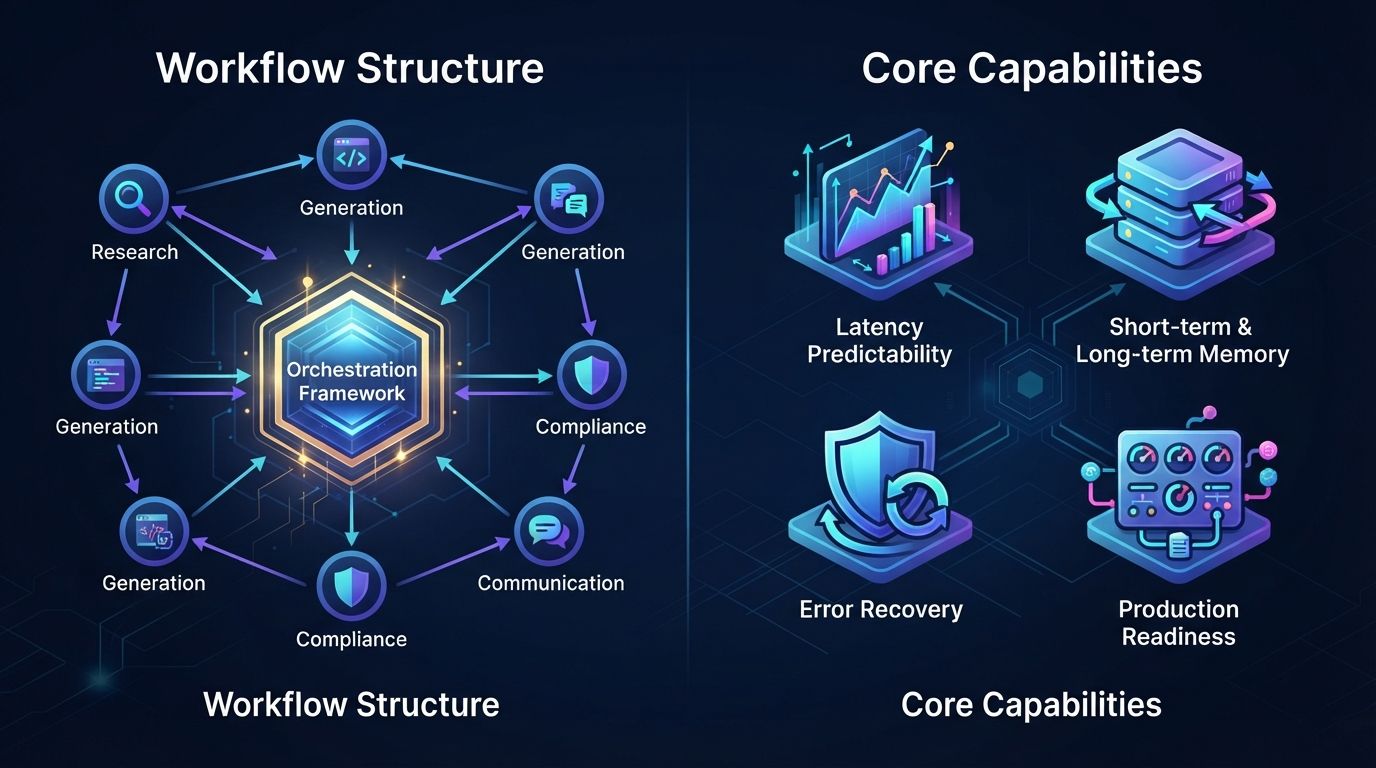
What Is Multi-Agent Orchestration?
Multi-agent orchestration is the coordination of several specialized LLM-powered agents (commonly used in AI & ML development), each with its own instructions, tools and context, so that they complete a task together under shared control logic.
An orchestration framework supplies four things: a way to define agents, a way to route work between them, a way to hold shared state, and a way to handle failure. A single agent with many tools is simpler, and it is often the right starting point. Teams move to multiple agents when one prompt becomes overloaded, when subtasks need different models or permissions, or when independent steps can run in parallel.
Why Framework Choice Is an Architecture Decision
Every framework embeds an opinion about control flow. Some make you draw the flow explicitly. Others let agents decide the flow at runtime. That single choice drives most of what you will experience later: how predictable latency is, how hard debugging becomes, and how safely the system recovers from a bad model output.
Three control-flow patterns cover most real systems:
- Graph or state machine: You define nodes and edges, and the model chooses only within the options you allow.
- Role-based pipeline: You define roles and tasks, and the framework runs them sequentially or hierarchically.
- Conversational or emergent: Agents exchange messages until a stopping condition is met.
The more freedom agents have, the more flexible the system is, and the harder it is to bound cost, latency and failure.
The Four-Dimension Evaluation Framework
We score frameworks on four dimensions that decide whether a multi-agent system survives contact with real users.
1. Latency
Latency in a multi-agent system is the sum of model calls on the critical path plus orchestration overhead. The biggest lever is not the framework itself but how many sequential LLM calls your design requires. Ask three questions: can independent steps run in parallel, can a cheaper model handle routing, and can you stream partial output to the user?
2. Memory
Memory has two layers. Short-term state is what agents share during one run. Long-term memory is what persists across sessions, such as user preferences, prior decisions and retrieved knowledge. Evaluate whether the framework gives you typed, inspectable state, whether it persists that state to a database you control, and whether it integrates with a vector store for retrieval.
3. Error Recovery
Agents fail in predictable ways: malformed tool arguments, hallucinated tool names, infinite loops, rate limits and upstream timeouts. Strong error recovery means retries with backoff, step-level checkpoints so a run can resume instead of restart, hard limits on iterations and spend, and a route to human review.
4. Production Readiness
Production readiness covers observability, deployment options, testing support, security controls and ecosystem maturity. A framework is production-ready when you can trace every step, replay a failed run, enforce guardrails on inputs and outputs, and upgrade without rewriting your system.
Comparison Summary
Ratings below are qualitative assessments based on each framework's documented design and common production patterns. Benchmark your own workload before committing, because results vary by model, tools and prompt design.
- LangGraph: Explicit state graph control; High latency predictability; Native branching parallel execution; Typed state plus persistence; Checkpoints, resume, and human-in-the-loop error recovery; Steeper learning curve; Strong production readiness; Compatible with any model provider; Best for complex, regulated workflows.
- CrewAI: Roles, tasks, and flows control; Medium latency predictability; Limited parallel execution via flows; Built-in memory options; Retries and task guardrails; Gentle learning curve; Growing production readiness; Compatible with any model provider; Best for content, research, and ops automation.
- AutoGen-style: Agent conversation control; Low to medium latency predictability; Possible parallel execution (more manual); Message history centric memory; Termination rules and manual error handling; Moderate learning curve; Moderate production readiness; Compatible with any model provider; Best for research and exploratory tasks.
- OpenAI Agents SDK: Agents with handoffs control; High latency predictability; Manual parallel execution with async code; Sessions and context objects memory; Guardrails and tracing error recovery; Gentle learning curve; Strong production readiness within its ecosystem; Optimized for OpenAI (others via adapters); Best for lean assistants and support flows.
Framework Deep Dives
LangGraph: Explicit Control for Complex Workflows
LangGraph models an application as a graph of nodes that read and write a shared state object. Edges, including conditional edges, decide what runs next. Because the topology is explicit, you can reason about worst-case behavior before you ship.
Strengths: Durable checkpointing so a failed run resumes from the last good step, built-in patterns for human approval, support for cycles such as plan, act, review, and clear parallel branches. Pairing it with PostgreSQL for persistence is a common and sturdy choice.
Trade-offs: More upfront design work and more boilerplate than role-based tools. Teams that skip schema design for the state object tend to pay for it later.
Choose it when: The workflow has compliance requirements (such as PCI-DSS compliant fintech architectures or HIPAA-compliant healthtech systems), long-running steps, approvals, or many complex branches.
CrewAI: Role-Based Collaboration with a Low Barrier
CrewAI organizes work as a crew of agents with roles, goals and tasks. It reads almost like a job description, which makes it easy for product and engineering teams to align on a design. Its flows layer adds more deterministic control when a pure role pipeline is not enough.
Strengths: Fast time to first working prototype, readable configuration, and a natural fit for research, drafting and review pipelines.
Trade-offs: Less granular control over execution paths than a graph, and debugging role interactions can be harder as crews grow. Add explicit iteration limits and logging early.
Choose it when: You need to validate an idea quickly, or the process maps cleanly to a sequence of specialist roles, such as modern web development workflows or SaaS automation pipelines.
AutoGen-Style Frameworks: Conversational Multi-Agent Systems
AutoGen popularized the idea of agents solving problems by talking to each other, including with a human participant. The ecosystem has evolved into multiple branches and successor projects, so check the current status and maintenance of whichever distribution you adopt before building on it.
Strengths: Flexible group-chat patterns, strong for exploratory reasoning and code-generation loops, and good for research where the path is not known in advance.
Trade-offs: Conversations can wander, token usage can grow quickly, and latency is the least predictable of the four approaches. Strict termination conditions are essential.
Choose it when: The problem is open-ended and the cost of exploration is acceptable.
OpenAI Agents SDK: Minimal Primitives, Fast Path to Production
The OpenAI Agents SDK keeps the surface area small: agents, tools, handoffs between agents, guardrails and built-in tracing. It is easy to adopt and easy to reason about when your design is a triage agent routing to specialists.
Strengths: Low boilerplate, first-class tracing, input and output guardrails, and a clean handoff abstraction.
Trade-offs: It is most natural inside the OpenAI ecosystem, and complex branching or durable long-running workflows require more custom engineering.
Choose it when: You want a small, maintainable system with a clear routing pattern and you are comfortable with a single-vendor core.
Architecture Patterns That Matter More Than the Framework
Four patterns improve reliability regardless of which framework you pick:
- Supervisor pattern: One coordinating agent delegates to specialists and merges results. It keeps control centralized and easy to audit.
- Bounded loops: Every agent loop gets a maximum iteration count, a token budget and a wall-clock timeout.
- Typed state: Define the shared state as a schema, and validate it between steps. Free-form text passed between agents is the most common source of silent failure.
- Tiered models: Use a small, fast model for routing and classification, and reserve larger models for reasoning-heavy steps. This is usually the cheapest way to cut latency.
Production Readiness Checklist
- Trace every model call and tool call with inputs, outputs, latency and cost.
- Persist state after each step so failed runs can resume.
- Validate tool arguments against a schema before execution.
- Add retries with exponential backoff, and a fallback model for provider outages.
- Enforce guardrails for sensitive data, prompt injection and unsafe actions (essential for enterprise cybersecurity and ransomware prevention).
- Create an evaluation set of real tasks, and run it on every prompt or model change.
- Define a human escalation path for low-confidence outputs.
- Set per-run cost ceilings and alert on anomalies.
Which Framework Should You Choose?
- Maximum control, auditability and resumable runs: LangGraph
- Fastest prototype with readable role definitions: CrewAI
- Open-ended exploration and research agents: AutoGen-style frameworks
- Small, maintainable routing system on OpenAI models: OpenAI Agents SDK
- Custom enterprise workflow with compliance needs: LangGraph, ideally with expert architecture support
Build it right the first time. Choosing a framework is the easy part. Designing state, guardrails, evaluation and deployment is where projects succeed or stall. DevLogix delivers custom AI and LLM development services, including multi-agent architecture design, RAG integration and production deployment. Talk to DevLogix about your AI project
Multi-Agent Systems and RAG
Most production agents need grounded knowledge. Retrieval gives agents access to private documents and fresh data, which reduces hallucination and keeps answers verifiable. If you are designing that layer, explore our insights on data science and vector databases or see how custom AI models integrate with cloud DevOps infrastructure for scalable deployments.
Frequently Asked Questions
What is the best multi-agent framework for production?
For workflows that need control, auditability and resumable execution, LangGraph is generally the strongest choice because it uses explicit state graphs with checkpointing. For smaller routing-style systems, the OpenAI Agents SDK is a lean alternative.
Is CrewAI or LangGraph better?
CrewAI is better for speed and readability when your process maps to roles. LangGraph is better when you need precise control over branching, retries and persistence. Many teams prototype in CrewAI and move complex workflows to LangGraph.
Do I need multiple agents, or is one agent enough?
Start with one agent and add more only when a single prompt becomes overloaded, subtasks need different tools or permissions, or independent steps can run in parallel. Extra agents add latency, cost and failure modes. If team scaling is an issue, consider IT staff augmentation to scale engineering teams or compare in-house developers vs staff augmentation.
How do you reduce latency in multi-agent systems?
Run independent steps in parallel, use a smaller model for routing, stream partial results, cap loop iterations, and cache repeated retrieval or tool results. Optimizing infrastructure with modern cloud practices can also significantly lower latency—see our guide on cloud cost optimization across AWS, Azure, and GCP.
How should multi-agent systems handle errors?
Validate tool arguments, retry with backoff, checkpoint state after each step, set hard limits on iterations and spend, and route low-confidence results to a human reviewer.
Can DevLogix build a custom multi-agent system?
Yes. DevLogix designs and deploys custom AI and LLM solutions, including multi-agent workflows, RAG pipelines and integrations with existing backend systems. Whether you are in Fintech, Healthcare, Legal, GovTech, Supply Chain, or Textile Manufacturing, our tailored engineering ensures seamless integration.
Conclusion
There is no universally best framework, only the best fit for your control, latency, memory and recovery requirements. Use explicit graphs when you need predictability, role-based tools when you need speed, conversational systems when you need exploration, and minimal SDKs when you need simplicity. Whatever you choose, bound your loops, type your state, trace everything and evaluate continuously. Avoid the common pitfalls that cause digital transformations to stall—learn why most digital transformations fail and how sovereign engineering saves them.
Ready to move from prototype to production? Contact DevLogix for custom AI and LLM development or learn more about DevLogix and our global engineering operations across KSA, MEA, Europe, and LATAM. You can also explore more insights on our DevLogix Blog or check our engineering guide on enterprise Next.js and React development.